

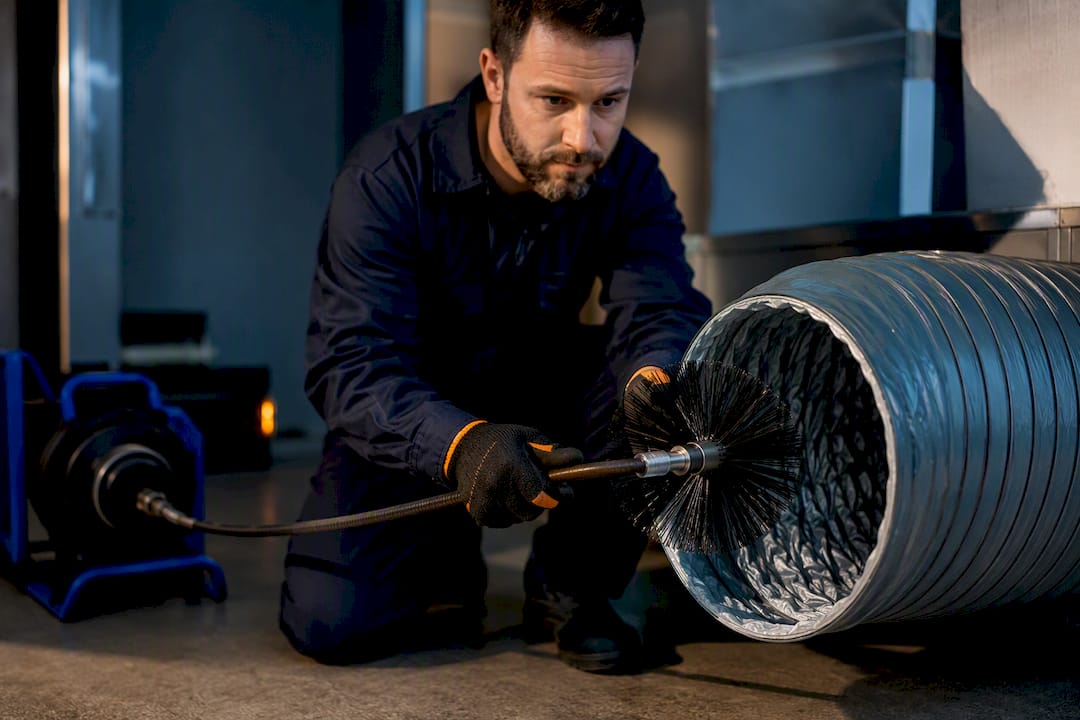
Yes. Rotary brushes can tear, snag, and puncture flexible ductwork when used by an inexperienced operator or on liner that’s already brittle. The tool itself isn’t the villain, wrong application is. Safer options exist, including air-whip agitation and soft-bristle tools paired with negative-pressure extraction, and a properly trained technician will check for both before touching your system.
TL;DR:
- Rotary brushes can cause tearing, puncturing, and insulation loss in flexible ducts if used improperly, especially without pressure monitoring and correct attachment choices.
- Damage risks include torn liners, punctures near seams, crushed sections, and detached joints, often exacerbated by excessive suction levels beyond manufacturer ratings.
- Safer cleaning methods involve air-whip agitation and soft-bristle tools paired with negative-pressure extraction to prevent liner damage in flex ductwork.
- Pre-inspection with camera footage and real-time pressure checks are essential steps to avoid unnecessary damage during duct cleaning.
- Homeowners should ask contractors about equipment specifics, inspection procedures, and damage policies before booking to ensure safe, effective service.
Table of Contents
- Rotary brush duct cleaning damage: what the tool is and why it’s used
- How rotary brushes damage flexible ductwork: the mechanics
- Signs of damage after a duct cleaning
- Safer methods for cleaning flexible ducts
- How reputable professionals prevent duct damage
- Should you clean, repair, or replace your ducts?
- What to ask a duct cleaning technician before booking
- Clean Vents’ approach to flex-duct safety
- How Clean Vents can help with safe duct cleaning, repair, or replacement
- Sources
- FAQ
Rotary brush duct cleaning damage: what the tool is and why it’s used
A rotary brush system is a rotating, motor-driven brush head fed through ductwork on a flexible shaft, to knock loose dust, debris, and buildup clinging to interior surfaces. Professional-grade rigs run off a controlled drive unit, often truck-mounted, with adjustable speed and torque settings matched to the duct material being cleaned. Cheaper setups skip that control entirely.
The brush shines on rigid, galvanized metal duct, where the surface can absorb friction without damage. Rotobrush’s own guidance on common cleaning methods notes that rotary agitation works well on hard ducting but is widely considered too aggressive for flexible, insulated runs.
Misuse tends to follow a pattern:
- A stiff-bristle head designed for metal gets used on flex duct without swapping to a softer attachment.
- The brush spins at full speed regardless of duct condition, with no feedback on resistance or drag.
- Hand-drill-driven brush heads, common among DIYers and budget operators, offer no speed governor and no sense of how much force is reaching the liner.
That last point matters more than most homeowners realize. A drill chucked to a brush shaft has no way to signal when it’s snagging thin plastic film instead of loose dust.
How rotary brushes damage flexible ductwork: the mechanics
Flex duct is built in three layers: an inner plastic liner (often polyethylene), a helical steel wire coil that gives it shape, and an outer insulated jacket wrapped around both. The liner is the working surface air actually travels through, and it’s thin by design, built for flexibility, not abrasion resistance.
When a rotary brush contacts that liner at speed, several failure modes show up:
- Torn liner: bristles catch and rip the plastic film, especially at bends where the brush presses harder against one wall.
- Punctures: a stiff or worn brush head can poke straight through, especially near seams.
- Crushed or kinked runs: excess force or a stuck brush head can collapse a section entirely.
- Detached seams and joints: vibration and torque work connections loose over a full run.
- Insulation loss: once the liner breaches, insulation fibres migrate into the airstream.
Uncontrolled torque and excessive negative pressure compound the risk. ACHR News reports that portable negative-air machines generate suction levels that often exceed the rated limits for flex duct manufacturers, and truck-mounted units can generate significantly higher suction, far beyond the safe rating specified by the manufacturers. Combine that suction with a spinning brush head and a thin liner has little chance.
Signs of damage after a duct cleaning
Some damage announces itself immediately. Other damage hides until your energy bill or your allergies tell you something’s wrong. Here’s how to check.
- Listen for new sounds. A whistling, rattling, or hissing noise from vents that wasn’t there before a cleaning points to a tear or a loosened joint.
- Check airflow at each register. Weak or uneven airflow, especially if one room suddenly runs colder or warmer than the rest of the house, suggests a collapsed or disconnected run.
- Inspect visible ducts. In an attic, basement, or crawlspace, look for insulation fibres near duct joints, sagging sections, or visible daylight through the jacket.
- Feel around seams and connections. A faint stream of air where there shouldn’t be one usually means a seam let go.
- Compare your energy use. A jump in heating or cooling costs right after a cleaning is a red flag worth investigating.
Pro Tip: Take photos of your visible ductwork before any cleaning appointment. If something looks different afterward, you’ll have your own before-and-after record, not just the technician’s word.
Safer methods for cleaning flexible ducts
Air-whip tools (sometimes called air-skippers) use a whipping compressed-air line instead of bristles. The line snaps and flexes inside the duct, knocking dust loose through vibration and air movement rather than direct contact. It’s effective on flex duct precisely because it doesn’t drag anything across the liner.
Soft-bristle tools exist too, built with pliable material that agitates without cutting. Paired with negative-pressure vacuuming, sometimes called source removal, the combination captures debris at the point of collection instead of blowing it further down the line or into your living space.
- Air-whip agitation loosens debris without abrading the plastic liner.
- Soft-bristle heads provide gentler contact when agitation alone isn’t enough.
- Negative-pressure extraction with HEPA filtration pulls loosened material out of the system rather than redistributing it.
Sometimes cleaning isn’t the answer at all. If a section is already torn, crushed, or showing pervasive mould, cleaning it won’t fix the underlying problem. Targeted replacement of that section is often the safer and cheaper long-term move.
How reputable professionals prevent duct damage
Damage prevention starts before any tool touches your ductwork. A technician who skips the inspection step is taking a guess at what’s inside your system, and guessing is how liners get torn.
- Pre-cleaning inspection. A visual walk-through combined with camera scope footage shows exactly what condition your ducts are in before work begins. Brittle, already-damaged sections should be flagged, documented, and excluded from aggressive cleaning methods rather than pushed through anyway.
- Pressure monitoring. A manometer measures negative pressure in real time, keeping suction within limits appropriate for flex duct rather than the higher levels rigid metal duct can tolerate.
- HEPA-filtered extraction. Debris pulled from the system gets captured and contained rather than recirculated through your home’s air.
- Method matching. Flex duct gets air-whip or soft-bristle treatment; rigid metal duct can handle rotary brushing when warranted.
Pre-cleaning camera inspection is the single most important damage-prevention step in the entire process. A technician who skips it is taking on risk the homeowner never agreed to.
Clean Vents technicians hold INCV certification and follow inspection and pressure-control practices aligned with NADCA’s guidance on containment and hazard awareness, which also flags hidden hazards like asbestos and lead-based materials that pre-inspection is meant to catch before work starts. Homeowners can read more on the equipment professionals actually use and what separates a careful setup from a rushed one.
Should you clean, repair, or replace your ducts?
Not every duct problem calls for the same fix, and understanding when it’s worth it helps homeowners make informed decisions. Matching the right response to the actual condition of your ductwork saves money and prevents unnecessary risk.
- Clean if: you’re dealing with ordinary dust, moderate debris, or reduced airflow with no signs of water intrusion or microbial growth. The DOHS fact sheet on HVAC duct cleaning lists these as legitimate reasons to clean.
- Repair if: a specific section shows a small tear, a loose seam, or minor insulation displacement, but the rest of the run is sound.
- Replace if: the liner is torn through, insulation is pervasively wet or mouldy, or the material is brittle enough that any handling risks further damage.
Replacement costs more upfront than cleaning but avoids throwing money at a system that will keep failing. A torn liner rarely holds up to a second attempt at repair.
What to ask a duct cleaning technician before booking
The right questions upfront save you from damage after the fact.
- “Can I see camera footage from the pre-inspection before work starts?”
- “What equipment will you use on flex duct specifically, and how does it differ from what you’d use on metal duct?”
- “Do you check and record negative pressure with a manometer during the job?”
- “Is HEPA-filtered extraction part of your process?”
- “What’s your policy if a section gets damaged during cleaning?”
Red flags include a technician who won’t show inspection images, insists rotary brushing works fine on flex duct regardless of condition, keeps pricing vague until after the job starts, or has no stated repair policy.
Pro Tip: Ask the question about equipment before the appointment, not during it. A company confident in its process will answer without hesitation.
For more on vetting a contractor properly, see this guide on when to hire a pro and how to pick one.
Clean Vents’ approach to flex-duct safety
We treat flexible duct as a different job than metal duct, not a smaller version of the same one. That means pre-inspection first, camera footage on request, and a refusal to run aggressive rotary brushing on flex liner regardless of how the job was originally quoted.
We’ll walk you through our equipment and show you what the camera sees before anything gets touched.
— Clean Vents
How Clean Vents can help with safe duct cleaning, repair, or replacement
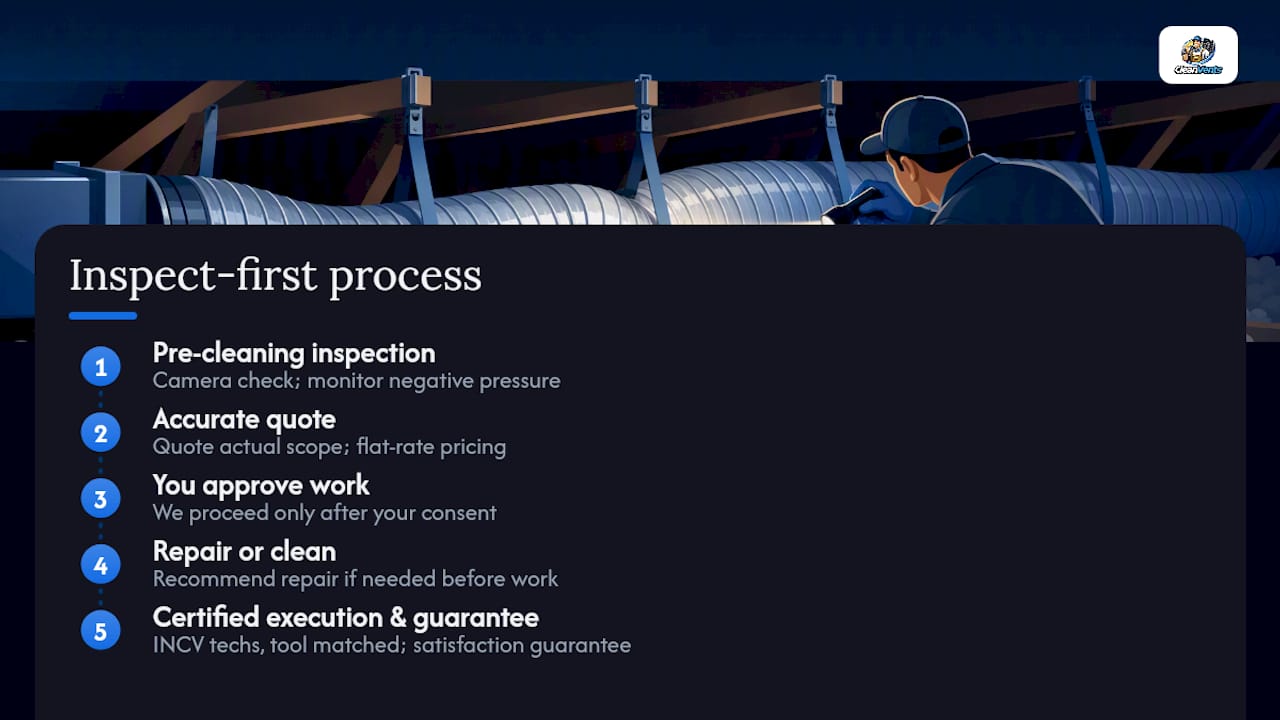
If your ducts include flexible sections, the method matters as much as the technician. Clean Vents runs pre-cleaning camera inspections and monitors negative pressure throughout the job, matching the tool to the duct rather than defaulting to whatever’s on the truck. Our technicians hold INCV certification and follow that path on every booking, residential or commercial, across Laval and surrounding communities.

The process is simple: we inspect first, quote the actual scope of work, and only proceed once you’ve agreed to it. If a section needs repair instead of cleaning, we’ll say so before starting, not after something’s already damaged. Every job is backed by a satisfaction guarantee and upfront flat-rate pricing, no surprise charges once the truck’s in your driveway.
Ready to see what’s actually happening inside your ductwork? Book an inspection through our air duct cleaning service and get a camera-verified look before any cleaning method gets chosen.
Sources
This article draws on the DOHS fact sheet on HVAC duct cleaning, NADCA’s hidden hazards guidance, ACHR News’s reporting on negative-pressure effects, and trade resources from Rotobrush and RemexUSA on common damage patterns and prevention.
- DOHS fact sheet on HVAC duct cleaning (NIH Office of Research Services)
- Hidden hazards in duct cleaning (NADCA)
- Effects of negative air duct cleaning on flex ducting (ACHR News)
- Common air duct cleaning methods (Rotobrush)
FAQ
Can duct cleaning cause damage?
Yes, particularly to flexible ductwork when a technician uses a stiff rotary brush or applies excessive negative pressure. Damage is preventable with proper method matching and pressure monitoring.
What is a rotary duct cleaning brush?
It’s a rotating, motor-driven brush head fed through ductwork to loosen dust and debris, typically run off a controlled drive unit. It works well on rigid metal duct but is generally too aggressive for flexible insulated ducting.
Does duct cleaning make a mess in your house?
It shouldn’t, as long as the contractor uses negative-pressure extraction with HEPA filtration to contain debris at the source. A mess afterward usually signals a containment failure or a liner breach during the job.
Is air duct cleaning a rip-off?
Not when it’s warranted and done correctly. The DOHS fact sheet notes cleaning offers clear benefit for water damage, visible mould, or airflow restriction, though routine cleaning without a specific problem has less consistent evidence behind it.
Is a rotary brush safe for flexible ducts?
Only in limited, controlled circumstances with a soft-bristle attachment and a trained operator monitoring pressure and force. For most flexible duct jobs, air-whip agitation paired with negative-pressure extraction is the safer standard, an approach Clean Vents applies on every flex-duct booking.