

Aim for a professional inspection every year and schedule commercial duct cleaning based on inspection findings rather than a fixed interval. The interval isn’t fixed. It moves based on your facility type, occupancy, and visible contamination, and the inspection is what tells you where you fall on that schedule. Bodies like NADCA back this inspection-first approach, and Clean Vents applies the same logic on every commercial job it quotes.
TL;DR:
- Regular inspections, rather than fixed schedules, determine cleaning frequency based on contamination levels and building conditions.
- High-risk environments like healthcare facilities and kitchens require more frequent cleaning due to faster contamination buildup.
- Visible dust, odours, airflow issues, and occupant complaints are key indicators that trigger early inspections or cleaning.
- Camera inspections and documented findings help avoid unnecessary work and ensure targeted, effective duct cleaning.
- Costs vary significantly depending on system size and contamination, with detailed quotes based on scope and inspection footage.
Table of Contents
- What’s the right commercial duct cleaning frequency?
- What pushes a building toward a shorter interval?
- Building an inspection checklist that actually catches problems
- Cleaning frequency by building type: a quick reference
- Turning the schedule into a real maintenance programme
- What does commercial duct cleaning actually cost, and how long does it take?
- Why Clean Vents builds every schedule around the inspection, not the calendar
- Ready to schedule your commercial duct inspection?
- Where these recommendations come from
- Sources
- FAQ
What’s the right commercial duct cleaning frequency?
The baseline recommended interval is based on industry standards emphasizing inspection-driven cleaning schedules. It comes from how NADCA’s ACR standard structures its recommendations: inspect first, then let contamination levels dictate the cleaning date. A typical office or retail space that inspects clean early may extend the interval toward the longer end of the recommended range. A kitchen exhaust system covered in grease buildup can’t.
The EPA takes a similar position, stopping short of recommending routine cleaning for every building on a calendar basis. Its guidance favours cleaning “only as needed,” triggered by visible contamination or a known source rather than a blanket rule. That’s a meaningful distinction for a facility manager building a budget. It means the inspection report, not the calendar, is the document that should drive your purchase order.
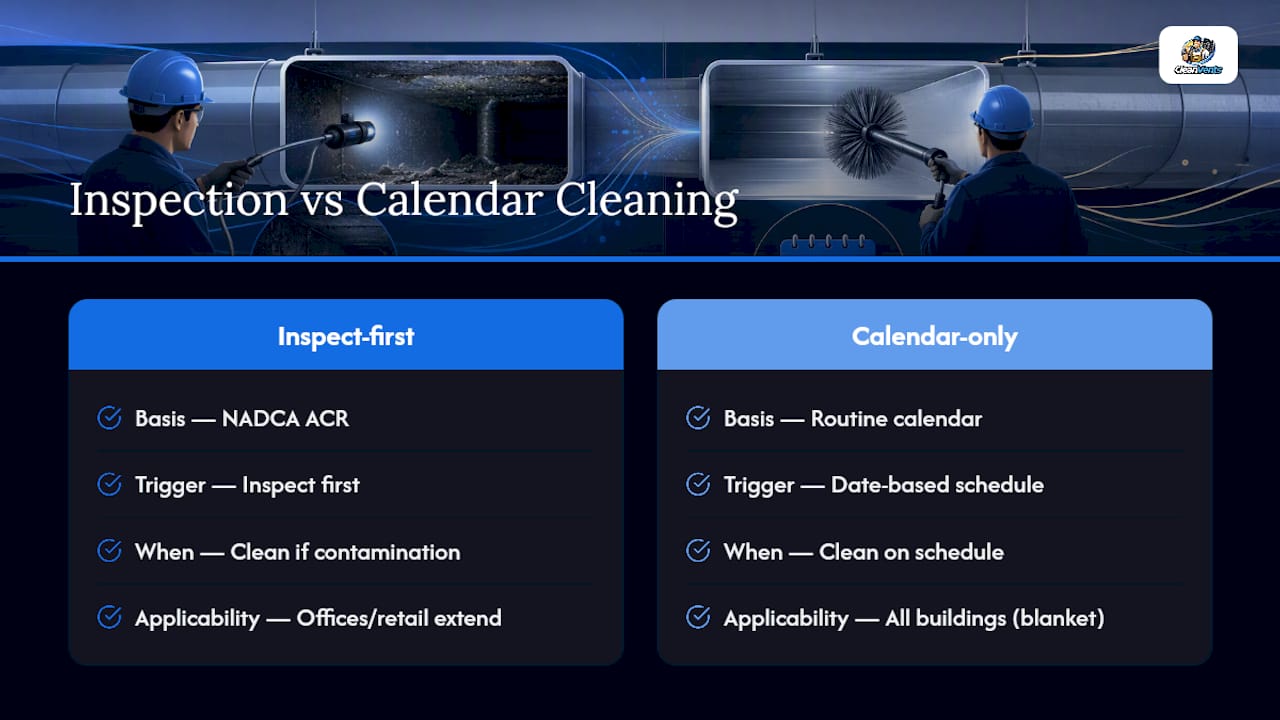
Skipping that inspection step doesn’t just risk poor air quality. It also means your HVAC system works harder to push air through restricted ductwork, which shows up in energy bills and shortened equipment life long before anyone notices dust on a vent cover.
What pushes a building toward a shorter interval?
Some facilities never make it to the five year mark, and a handful shouldn’t try. Healthcare facilities, commercial kitchens, and manufacturing plants often need more frequent cleanings due to rapid contamination accumulation. High-risk environments like labs and hospitals should treat their inspection interval as fixed, not aspirational.
The conditions that shorten your timeline usually fall into a short list:
- Grease and smoke buildup from commercial kitchen exhaust systems
- High foot traffic or heavy dust load from an industrial process
- Pets, carpeting, or other indoor sources that generate fine particulate
- Recent renovation or construction work that pushed drywall dust into the return air
- Visible moisture or mould growth anywhere in the system
- A cluster of occupant complaints, allergy flare-ups, or unexplained odour reports
- Rising energy bills or noticeably weaker airflow at the registers
Any one of these on its own might not move your schedule. Two or three together usually mean it’s time to call in an inspection regardless of when the last cleaning happened.
Pro Tip: Log every occupant complaint about stuffiness or odour with a date and location. A pattern across three or four reports in the same wing is often the clearest early signal that a duct section needs attention, well before an energy bill spike shows up.
Building an inspection checklist that actually catches problems
A useful inspection doesn’t require guesswork. It follows a repeatable sequence that any facilities team can run between professional visits.
- Check every supply register and return grille visually for dust buildup, discolouration, or staining.
- Run a camera inspection through the main trunk lines to see contamination a flashlight can’t reach.
- Note any odour, whether musty, burnt, or chemical, and record where it’s strongest.
- Check for moisture stains, condensation, or standing water near coils and drain pans.
- Compare airflow at several vents; weak spots often point to a blockage upstream.
- Photograph anything unusual, with the date, exact location, and a visible reference point for scale.
In-house staff can reasonably handle steps one and three on a monthly walkthrough. Camera inspections and moisture assessments belong with a NADCA or INCV-certified contractor, since that equipment and training determine whether a scope of work holds up if a tenant later disputes it.
Cleaning frequency by building type: a quick reference
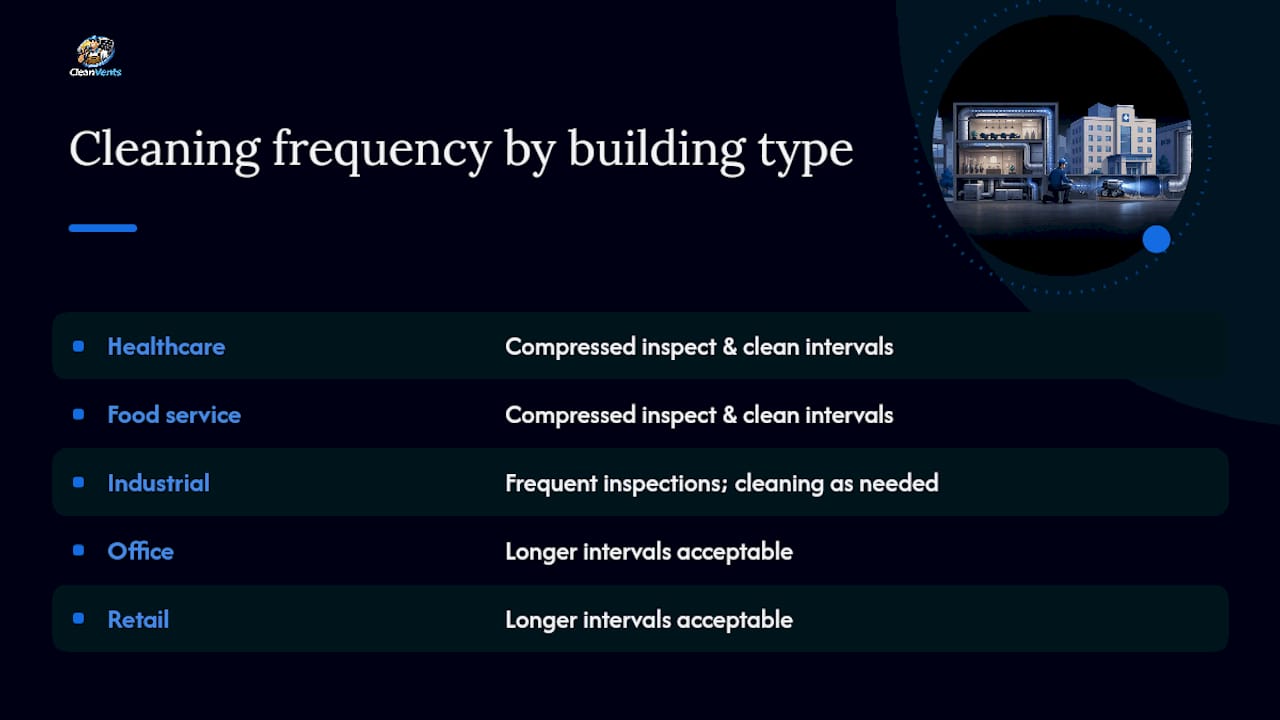
Facility type drives the schedule more than almost any other variable. A warehouse and a paediatric clinic simply cannot run on the same interval, and pretending otherwise is how buildings end up either overcleaning and overspending, or undercleaning and risking occupant health.
Inspection and cleaning intervals vary by building type. More frequent schedules are recommended for healthcare, food service, and industrial settings, and longer intervals are acceptable for offices and retail.
A few things stand out in that table. Healthcare and food service compress both intervals because contamination risk and regulatory exposure are higher. Industrial sites inspect most often because dust and debris accumulate fast, but that doesn’t always mean cleaning happens more often. It means someone is watching closely enough to know when it’s genuinely necessary.
Trade guidance broadly confirms these ranges, though every regulated facility should check its own sector rules before locking in a number.
Turning the schedule into a real maintenance programme
A frequency guideline only helps if it turns into a process someone actually follows. That means writing down the inspection cadence, the specific conditions that trigger an early cleaning, and what documentation you expect back from any contractor.
- Set your inspection cadence by building type using the ranges above, and put it on a shared calendar.
- Define the triggers, like a moisture finding or a complaint spike, that override the calendar and move up your cleaning date.
- Require documentation on every job: camera footage, before and after photos, and containment procedures where dust or mould exposure is a concern.
- Track three KPIs over time: IAQ complaint volume, airflow recovery after cleaning, and energy trends against your baseline.
Pro Tip: Ask any contractor to include camera footage as a standard line item in their quote, not an upsell. It settles disputes over scope before they start and gives you a documented baseline to compare against next inspection.
What does commercial duct cleaning actually cost, and how long does it take?
Cost and duration swing on three variables: system size, access difficulty, and what kind of contamination you’re dealing with. Grease removal in a commercial kitchen takes longer and costs more than routine dust clearing in an office building, and ductwork buried above a finished ceiling adds labour that open plenum systems don’t require.
A small office suite is often finished in a matter of hours. A large facility with multiple air handlers may need to be phased across several days to avoid shutting down operations entirely. Whatever the scope, request an itemised quote built around a camera-based scope of work rather than a flat number. It’s the only way to know exactly what you’re paying for before the crew shows up.
Why Clean Vents builds every schedule around the inspection, not the calendar
Clean Vents doesn’t quote a cleaning date before looking at the system. Every commercial job starts with a camera inspection, run by INCV-certified technicians, because a calendar guess is a poor substitute for footage of the actual duct interior. That inspection produces a report with photos, documented findings, and a scope of work the client can review before committing to a service date.
Clients get more than a cleaning invoice. They get a record: what the ducts looked like, where the contamination sat, and why the recommended interval makes sense for their specific building. That’s the standard Clean Vents holds itself to on every commercial property it services, regardless of size.
— Clean Vents
Ready to schedule your commercial duct inspection?
If you’ve read this far, you already know the calendar alone won’t tell you when your ducts need attention. Clean Vents is built around that exact problem: every commercial job starts with a documented camera inspection, not a guess, so you know precisely what you’re paying to fix before any work begins.
The service includes the inspection, the camera report with photos and findings, and, where cleaning is warranted, a full commercial cleaning backed by INCV-certified technicians. That combination means you’re never buying a cleaning you don’t need, and you’re never skipping one your system actually requires. If your building falls into a high-risk category, food service, healthcare, or a recently renovated space, an inspection now is the cheapest way to find out where you stand. Book a commercial duct inspection with Clean Vents and get a documented scope of work before you commit to a cleaning date.
Where these recommendations come from
The frequency guidance above draws on the NADCA ACR standard, EPA indoor air quality guidance, NIOSH workplace health hazard evaluations, and practical frequency benchmarks from trade industry guidance.
Sources
- NIOSH health hazard evaluation report (2019-0240-3410)
- Should you have the air ducts in your home cleaned? | US EPA
- Commercial Air Duct Cleaning Frequency: Full Guide
FAQ
How often should I get duct cleaning done?
Most commercial buildings benefit from regular inspections and cleaning guided by contamination levels; healthcare and food service facilities typically require more frequent maintenance due to higher risk.
What time of year is best for duct cleaning?
Spring and fall tend to work best because HVAC systems run less intensively then, making it easier to schedule cleaning without disrupting heating or cooling during peak demand.
What are the signs air ducts need cleaning?
Watch for visible dust or debris at vents, musty or burnt odours, weaker airflow, rising energy bills, and a spike in occupant complaints about stuffiness or allergies.
Does cleaning air ducts really make a difference?
Yes, when contamination is present. The EPA notes that cleaning helps most when there’s a known source of buildup, and removing grease, dust, or mould restores airflow and can ease strain on HVAC equipment.