

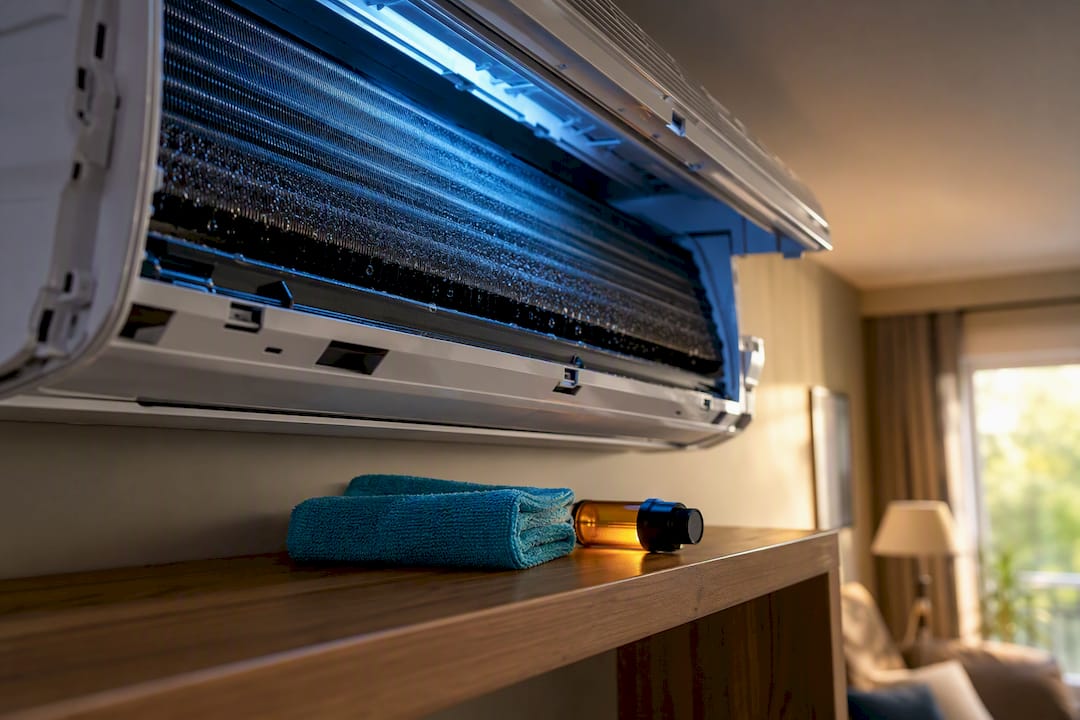
That musty, sock-drawer smell when your mini split kicks on almost always points to mould or bacteria growing on the evaporator coil, the blower wheel, or standing water in the drip pan and drain line. If the odour is strong, shut the unit off, pull the filter for a wash, and check the condensate drain before you do anything else.
TL;DR:
- Mold growth on the evaporator coil, blower wheel, or drain line causes musty smells, especially during humid months when condensation and dust feed mold spores.
- Checking airflow, drainage, and visible mold patches helps identify the source; a smell at startup that diminishes suggests internal contamination.
- DIY cleaning with proper precautions can address surface mold and dirt, but persistent smells or visible growth require professional disassembly and cleaning.
- Regular maintenance, including filter washing every 30 to 90 days and professional cleaning twice a year, prevents mold recurrence by controlling moisture and dust.
- In cases of recurring odor, visible mold, or water leaks, a certified technician should perform thorough cleaning, drain line clearing, and coil disinfection.
Table of Contents
- What causes mold smell in a mini split?
- How do I know if my mini split is the source of the smell?
- Safe DIY cleaning steps for filters, housing, and the drip pan
- When should you call a professional for mini split mold?
- How do you stop mold from coming back in a mini split?
- Quick troubleshooting checklist for a musty mini split
- When professional cleaning is the smarter call
- Book a mini split cleaning that actually reaches the coil
- Sources
- FAQ
What causes mold smell in a mini split?
A mini split’s indoor head is a small, damp, dark box that runs cold and wet for hours at a time. That combination, cool metal, condensation, and low light, is close to ideal for mould and bacterial growth, and it’s why the smell tends to show up in the humid months first.
The evaporator coil collects condensation every time the unit cools. Dust drawn in through the return air settles on that wet surface and gives mould something to feed on. According to FilterBuy’s guide on mini split mould, the coil, blower wheel, and drip pan are the three spots where growth shows up almost every time, and the giveaway is a musty “dirty sock” smell right when the unit starts up.
The blower wheel sits directly behind the coil and pushes air across it. Once mould gets a foothold on the coil, spores land on the blower’s curved fins, and every time it spins, it flings a fresh dose of odour and spores through the room. Trade sources describe this as a recurring late-summer nuisance, and running the fan on its own after a cooling cycle helps keep the blower drier between uses, according to Eagle Pipe Mechanical’s write-up on blower wheel mould.
Then there’s drainage. The condensate drain line and drip pan carry that coil water outside the house. A clog, a sagging line, or a unit installed slightly out of level lets water pool instead of flow, and stagnant water in a warm plastic pan is basically a mould incubator. Fine Homebuilding’s field notes on mini split mould point to exactly these mechanical issues, clogged lines, unlevel heads, and missing tubing insulation, as the most common reasons a unit that was fine last year suddenly reeks this year.
The usual suspects, in order of how often they’re the actual source:
- Evaporator coil coated in dust and condensation
- Blower wheel contaminated with spores from the coil
- Clogged or sagging condensate drain line
- Drip pan holding standing water
- Missing or degraded insulation on the refrigerant lines, which lets outside condensation form where you can’t see it
Installation quality matters more than most homeowners realize. A head mounted slightly out of level, even by a few degrees, can be enough to stop the pan from draining properly, and it’s a problem you’d never spot just by looking at the unit from the floor.
How do I know if my mini split is the source of the smell?
Start by paying attention to timing. If the smell hits the moment the compressor kicks in and fades as the unit keeps running, that’s a strong sign the growth is inside the unit itself rather than somewhere else in the room.
Work through these checks in order:
- Note when the smell appears. A burst of musty odour at startup that fades after a minute or two usually means internal coil or blower contamination.
- Look for visible signs. Pull the front cover and check the coil fins and blower blades with a flashlight for black or grey spots, slime, or a fuzzy coating.
- Check airflow. Weak or uneven airflow compared to when the unit was new often means a dirty filter or coil is restricting the air path.
- Run the condensate drain test. Pour roughly one litre of water directly onto the indoor coil and watch the exterior drain line. Fine Homebuilding recommends this pour test as the fastest way to confirm whether water is draining freely or backing up somewhere in the line.
- Measure indoor humidity. A cheap hygrometer tells you fast whether the room’s relative humidity is feeding the problem.
Statistic to know: Indoor relative humidity above roughly 50% is a strong driver of mould growth indoors, while keeping it in the 30 to 50 percent range sharply cuts the odds of colonization.
Safe DIY cleaning steps for filters, housing, and the drip pan
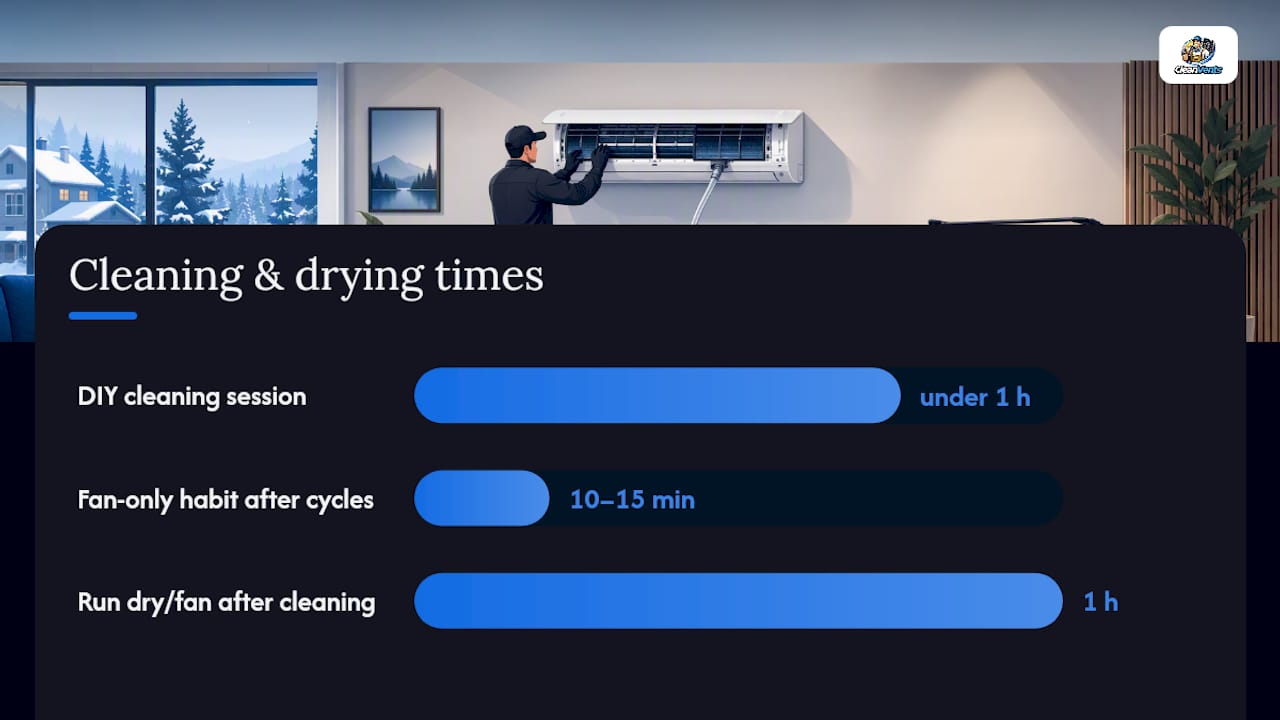
Most of what causes the smell is reachable without opening up the refrigerant side of the unit, and a lot of it you can tackle yourself in under an hour.
- Cut the power first. Switch off the unit at the wall or breaker before you touch anything, and put on a mask, gloves, and eye protection. Mould spores kicked loose from a filter are not something you want to breathe in or get in your eyes.
- Pull the mesh filter and wash it. Rinse it under running water, use a soft brush for stuck-on dust, and let it dry completely before putting it back. A damp filter reinstalled too soon just restarts the mould cycle.
- Wipe down the accessible housing and drip pan. A cloth with mild dish detergent and warm water handles the plastic housing, the louvres, and the visible part of the drip pan just fine.
- Leave the coil alone unless you’re following manufacturer instructions. Spraying cleaner directly onto the coil fins without the right product or technique can bend them or push contamination further into the unit instead of removing it.
- Run dry or fan mode for an hour once you’re done. This dries out the coil and housing so you’re not sealing moisture back in behind a clean-looking filter.
Pro Tip: Run the fan-only setting for 10 to 15 minutes after every cooling cycle, not just after a cleaning. It’s a free habit that keeps the coil from sitting wet overnight, which is when a lot of blower wheel contamination gets its start.
Watch for two signs that you’ve hit the ceiling of what DIY cleaning can fix. If the smell comes right back within a few days of cleaning the filter and housing, the growth is deeper than what you can reach, and professional mattress odor removal services can help eliminate smells at the source. And if your flashlight check turned up visible black or slimy patches on the coil or blower wheel itself, that’s not a job for dish soap and a cloth. If drainage issues keep resurfacing after cleaning, a dripping mini split usually points to a mechanical fix rather than a cleaning one.
When should you call a professional for mini split mold?
Some situations call for a technician, no debate. If the smell returns within days of a thorough filter and housing clean, if your flashlight check shows mould on the coil or blower wheel rather than just the housing, or if you’re seeing actual water leaking from the unit, it’s time to book a visit.
The same goes for anything covering more than a small, easily wiped surface, and for households with anyone who has asthma, allergies, or a compromised immune system. Mould exposure is a recognized trigger for allergic and respiratory symptoms in sensitive people, according to the Asthma and Allergy Foundation of America, and that’s not a risk worth managing with a wait-and-see approach.
A proper professional visit should include:
- Full disassembly of the coil and blower wheel for direct cleaning, not just a surface wipe
- Drain line clearing and a post-service drainage test
- Pan treatment where standing water has been an issue
- Before-and-after photos so you can see what actually got fixed
Ask any technician for proof of certification, such as INCV training, a written scope of work, and a fixed price before they start. If mould has spread into ductwork rather than staying contained to the mini split head, musty smells from vents point to a broader duct inspection.
How do you stop mold from coming back in a mini split?
Prevention comes down to controlling moisture and keeping dust off the coil, and most of it is habit rather than equipment.
Keep indoor relative humidity in the 30 to 50 percent range that health authorities associate with lower respiratory risk and reduced mould growth. In a tightly sealed home, opening a window doesn’t do much; a mechanical dehumidifier or the mini split’s own dry mode does far more of the actual work, particularly in basements or rooms that run humid year round.
Statistic to know: Manufacturer and industry guidance generally recommends washing a mini split’s filter every 30 to 90 days depending on dust and pet hair in the home, alongside a full professional cleaning once or twice a year.
Build these into your routine:
- Run dry or dehumidify mode during humid stretches, not just cooling mode
- Let the fan run 10 to 15 minutes after each cooling cycle to dry the coil
- Wash the filter on a fixed schedule instead of waiting for it to look dirty
- Book a professional coil and blower cleaning annually, or twice a year in humid climates or heavy-use households
- Confirm the indoor head is mounted level and that refrigerant lines have intact insulation where they pass through unconditioned space
If you’re troubleshooting airflow or cooling complaints alongside the smell, a mini split not cooling properly often traces back to the same dirty coil that’s causing the odour.
Quick troubleshooting checklist for a musty mini split
- Shut the unit off and ventilate the room if the smell is strong.
- Remove and wash the filter, and inspect accessible housing for spots or slime.
- Pour one litre of water on the coil and confirm it drains freely outside.
- Run fan or dry mode for an hour and see whether the smell returns.
- If it comes back, photograph the coil and blower and call a professional.
When professional cleaning is the smarter call
Homeowners often try to fix a coil or blower problem with filter swaps alone, and it rarely holds. A wet, dusty coil needs disassembly to clean properly, not a spray from the outside.
Clean Vents sends INCV-trained technicians specifically for wall AC and mini split cleaning, and we recommend a visit whenever the smell survives a proper DIY clean, when there’s visible growth on the coil or blower, or when anyone in the home is sensitive to allergens. A real service visit means an actual inspection with photos, coil and blower cleaning where the contamination calls for it, drain-line clearing, and pricing you see before we start, not after.
— Clean Vents
Book a mini split cleaning that actually reaches the coil
A filter wash handles surface dust. It doesn’t touch what’s growing on a coil or blower wheel, and that’s the gap Clean Vents exists to close for homeowners in Laval and the surrounding area.
Every visit includes a full inspection, coil and blower cleaning by INCV-trained technicians, drain-line clearing, and flat-rate pricing agreed before any work starts, backed by a satisfaction guarantee. If your unit has been giving off that musty smell for more than a week despite a filter change, book a wall AC and mini split cleaning and get a technician looking at the actual source instead of guessing from the couch.
Sources
For deeper reading on how indoor dampness affects health, see the World Health Organization’s guidance on damp and mould and the peer-reviewed research on dampness and respiratory symptoms published in PMC.
- WHO — Damp and mould in buildings (publication)
- FilterBuy — Mold in your mini split: warning signs, removal & prevention
FAQ
Will mold in my AC unit make me sick?
Mould exposure can trigger allergic and respiratory symptoms in sensitive people, according to the Asthma and Allergy Foundation of America, though reactions vary a lot depending on individual sensitivity and how much mould is present.
Are mini splits more prone to mold than central air systems?
Mini splits run their coil and blower in a compact, low-airflow enclosure close to living space, which gives moisture and dust less room to disperse than in a central system’s ductwork, making mould buildup easier to notice quickly.
Is it bad if my AC smells like mildew?
Yes. A mildew smell almost always signals active mould or bacterial growth on the coil, blower, or drain pan, and it’s worth investigating right away rather than masking with air fresheners.
Why does my split AC have a musty smell only when it starts up?
A smell that hits at startup and fades after a few minutes points to growth sitting on the coil or blower wheel itself, since that’s the moment the fan first pushes air across the contaminated surface.
How often should a mini split be professionally cleaned to prevent mold?
Most guidance points to a professional coil and blower cleaning once a year, or twice a year in humid climates or high-use households, alongside filter washing every 30 to 90 days between visits.